Browse the Workbench
Practical articles and quiet proof pieces for ranch and homestead brands.
How healthy soil biology helps you get more from every acre.
Let’s Talk About Your Next White Paper or Technical Insight
Author: Ken Whaley
Published: December 1, 2025
Focus: Soil biology, grazing days, forage performance
Most ranchers today face the same tight corner: land is expensive, feed keeps climbing, and weather doesn’t always cooperate. When you can’t buy more acres—and don’t want to throw more inputs at the ground—your options feel limited.
But there’s one tool many overlook: the biology already living in their soil.
This paper explains, in plain language, how soil biology works, why it matters, and what ranchers are seeing when they bring it back to life.
Anyone who runs cattle knows the pattern. Early season looks good. By midsummer, growth slows, pastures tighten up, and recovery lags. Soon enough, you’re feeding earlier than planned.
Buying more ground isn’t realistic. Renting gets harder each year. Inputs don’t fix the root issue.
So the real challenge becomes: how do you get more grazing days from the acres you already manage?
All three tie back to the same source: the life in the soil.
Compaction, low organic matter, heat stress, and years of salt-based fertilizers all chip away at soil life. By July or August, biology is running short. Grass looks tired. Recovery slows.
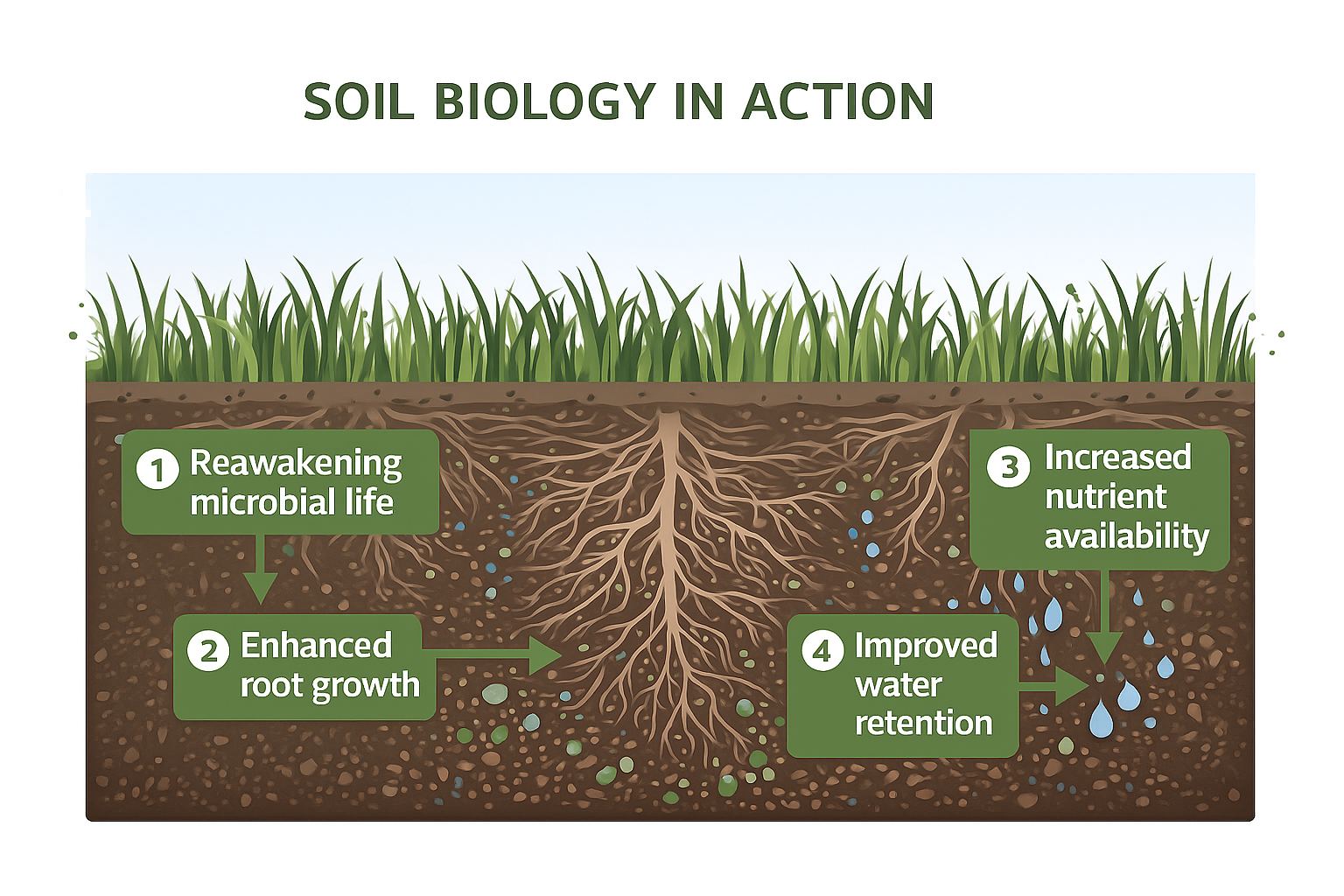
A good biological product doesn’t work by magic. It simply helps the soil function the way it was designed to.
1. Extended Grazing Windows
Many see 7 to 21 more days on pasture.
“We held cattle on grass a bit longer than usual — maybe a week or so. Enough to notice.”
— Cow–calf operator, western Montana
“Regrowth seemed steadier between moves. Not dramatic, just more consistent.”
— Rotational grazier, central Oregon
“Some thin spots filled in better than they normally do by midseason.”
— Family ranch, southern Idaho

2. Better Forage Density
Weak spots fill in. Bare patches shrink.
3. Improved Moisture Retention
Biology helps soil hold water longer.
4. Reduced Supplemental Feed Costs
Each extra grazing day delays hay season.
These aren’t formal case studies — just honest field notes.
Western Montana: Two extra weeks on early-rotation pasture.
Central Oregon: Faster recovery between rotations.
Southern Idaho: Better midseason resilience.
Northern Nevada: Stronger color despite low rainfall.
An honest product should offer:
This is where real product details would go in a commissioned version. This sample simply demonstrates structure.
Better biology → better grass → better margins. No miracles. Just healthier soil doing its job.
Practical articles and quiet proof pieces for ranch and homestead brands.
Send me a note — I will reply personally.